Why I built Nexus Contacts
I had a thousand contacts in my phone and couldn't tell you who half of them were.
Then someone took a selfie with me when we met. I never forgot them.
That is the whole idea, and everything below is just the detail.
You meet someone who matters. You both mean it. You say you'll follow up.
And two weeks later it's gone — not because you didn't care, but because the moment you meet someone is the worst possible moment to do data entry. Nobody wants to be the person typing into their phone while someone is still talking to them. So you don't. You mean to do it later, and later never has the context: not the name, not what you talked about, not the reason it mattered.
A connection you both actually wanted quietly doesn't happen. That is the whole failure, and it happens to everybody.
How it works
Take a selfie together. One tap. It takes about as long as saying goodbye.
Write one line about who they are. Not a form. One line, in your words, while you still remember why it mattered.
They're on your wall. A grid of faces, not a list of names — with where you met, when, and the line you wrote. Tap any face and everything you remembered is there, plus a running journal of everything since.
Send them your details without the awkward part. A card with the message already written — edit it if you want, send it if you don't. The photos from the moment attach to it. You can keep separate cards for separate contexts — personal, work, networking — and one of them is your default.
Follow up before it goes cold. An optional reminder, with a snooze for the days when it isn't going to happen.
The part I actually care about
It also records who introduced you — and who you've introduced to whom.
That sounds small. It isn't. The list of names was never the valuable thing; the graph is. Who connected you to whom, who you owe, how you are actually linked to the people you know. That structure is what every network business ever built has been built on top of, and it is the single most valuable thing anybody holds about you.
I don't think anyone has ever offered you custody of your own.
Where it lives
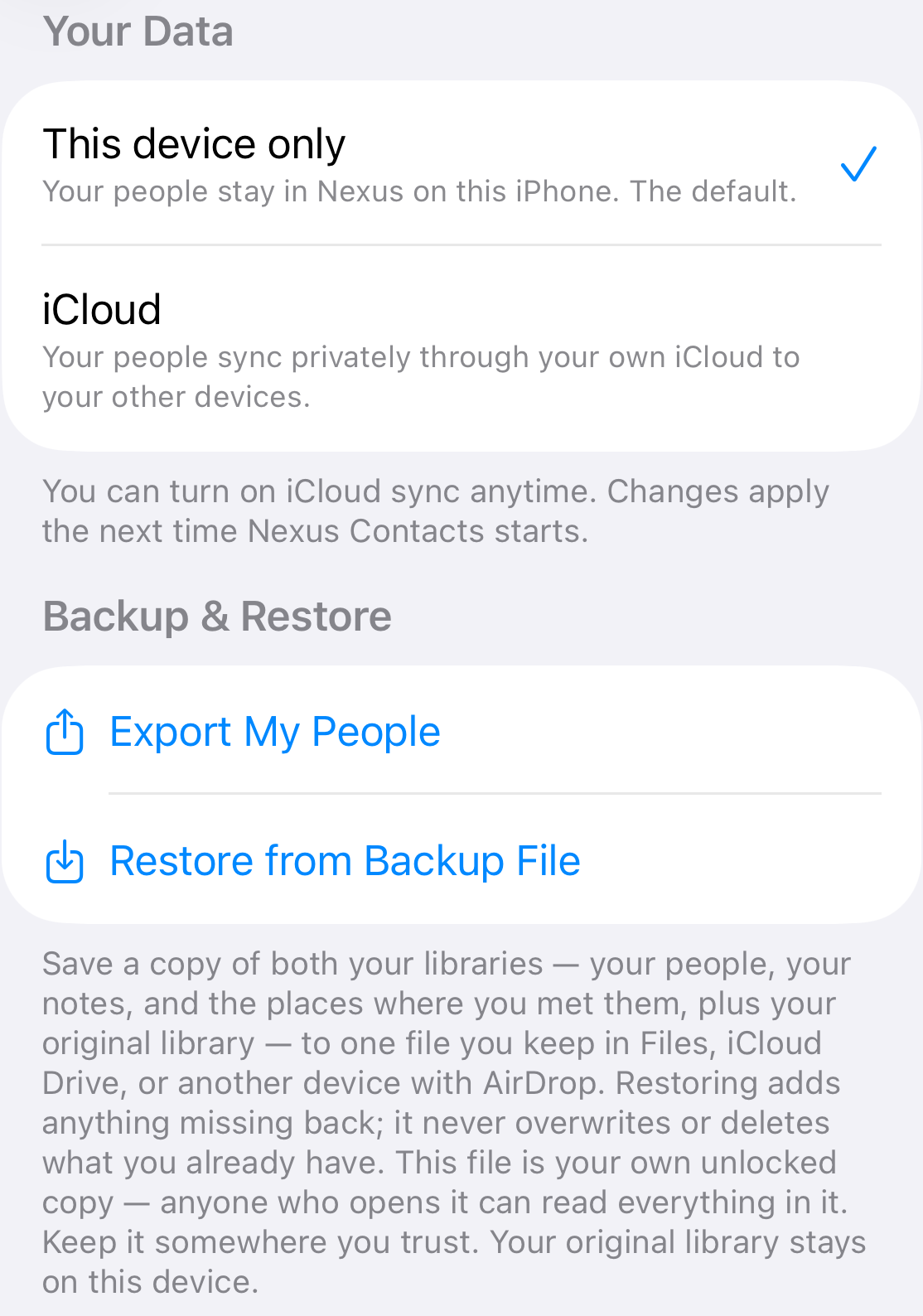
On your phone. That isn't a setting you have to go and find. The first option in the app is This device only, and the app's own description of it is: "Your people stay in Nexus on this iPhone. The default."
Sync is your own iCloud, and it's off until you turn it on. If you do turn it on, your people sync privately through your own iCloud to your own devices. There's a screen that tells you whether sync is actually working, rather than assuming it is.
Your backup is a file you can read yourself. Open it in a text editor in ten years, with no app installed, and it will tell you what it is and how to read it back.
The app is blunt about what that means — not in a callout, but in the middle of the paragraph explaining backups:
"…This file is your own unlocked copy — anyone who opens it can read everything in it. Keep it somewhere you trust. Your original library stays on this device."
Nobody made us write that. It's the honest cost of handing you a file that doesn't need us, and we'd rather you knew it than found out.
Nothing is held hostage. If you reach the free limit and never pay, nothing locks. What you've captured stays yours to read, edit, export and sync. Only adding new people pauses. Contacts already in your address book never count toward the limit at all.
And one thing you'd have no way to know unless we told you. When your coordinate goes to Apple, the app says so — right then, on the screen where it happened, in small grey text:
"The name of where you are was looked up through Apple as this screen opened, so Apple already has the coordinate. That happened on its own — before you filled anything in, and whether or not you save."
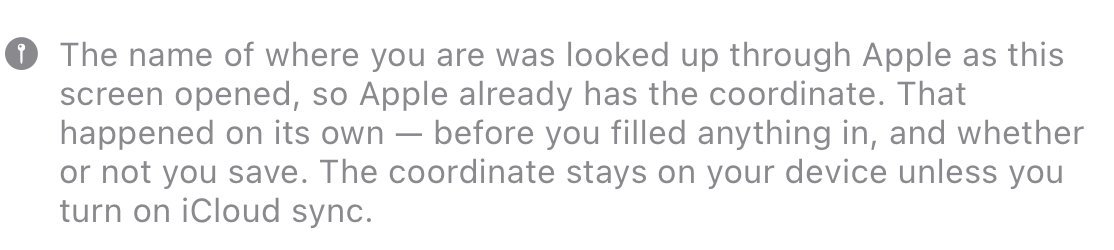
It says it even when the lookup comes back with nothing. Those are the times you would never have known — no place name appears, nothing is saved, and the coordinate left anyway. Telling you then is the only version of this that counts.
Nobody made us put that there either. It isn't flattering and it isn't required. But you cannot have custody of something you don't know you're carrying, so we tell you at the moment it happens.
What it costs
Free for the first 100 people you meet. Every feature included, forever. There are no feature gates — capacity is the only thing you can buy.
After that, $19.99 once for room for a thousand people, or $49.99 once for unlimited. Buy the first and want the second later, you pay the difference.
There is no subscription. Not a launch offer, not a discount — there isn't one to cancel.
And the count only includes people you capture in Nexus. Your address book never counts, however big it is.
Your relationships are yours. That shouldn't depend on us still being here.
Download on the App StoreRequires iOS 26.1 or later.